
Skip to content
Service 06Data & Pipelines

ETL and ELT Pipeline Development

Scheduled and incremental data pipelines that consolidate operational records into clean, query-ready analytical tables.

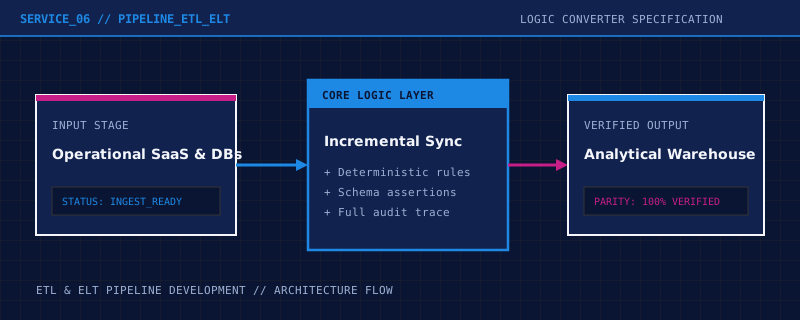
ETL and ELT Pipeline Development architecture flow diagram showing input stage, core logic layer, and verified output

01 · Problem & Audience

Why organisations need this

Reporting directly against live production databases slows down applications, and blending data from multiple SaaS tools manually in spreadsheets every month is slow and error-prone. Teams need reliable pipelines that extract operational data, normalise schemas, and load clean tables for analysis.

Designed For

  • Finance and operations teams needing consolidated reporting across multiple software platforms.
  • Data and engineering teams wanting reliable incremental extraction without overloading production databases.
  • Businesses moving from manual monthly spreadsheet consolidation to automated daily data refreshes.

02 · Scope & Process

How we execute ETL and ELT Pipeline Development

Phase 01

Source & Warehouse Assessment

We review source APIs/databases, update frequencies, data volumes, and your target database or warehouse environment.

Phase 02

Extraction Strategy (ETL vs ELT)

We decide whether to transform before loading (for strict privacy/filtering) or load raw staging tables and transform in-warehouse (ELT).

Phase 03

Incremental Sync & Schema Modelling

We implement cursor/watermark tracking, deduplication, and SQL/code transformations with automated data tests.

Phase 04

Scheduling & Alerting Setup

We configure run schedules, freshness checks, and failure alerts.

03 · Practical Benefits

Operational Outcomes

  • +Incremental extraction reduces load on source systems and keeps run times predictable.
  • +Idempotent pipeline runs allow safe backfills without duplicating historical rows.
  • +Automated schema-drift detection catches upstream API changes before reports silently break.
  • +Clean, documented tables ready for BI tools or internal applications.

04 · Deliverables

What You Receive

  • →Extraction and loading connectors or scripts.
  • →Version-controlled transformation models and schema definitions.
  • →Automated data integrity and freshness checks.
  • →Pipeline architecture and backfill runbook.

05 · Boundaries & Dependencies

Scope Limitations

Transparent engineering constraints

  • Data freshness is bounded by source system API rate limits and export windows.
  • Dashboard visual design is separate from pipeline engineering, though we ensure tables match your reporting tool requirements.

06 · Service FAQs

Common questions about ETL and ELT Pipeline Development

Should we use ETL or ELT?

If you have a modern cloud database or warehouse, ELT (loading raw data into staging, then transforming via version-controlled SQL) is often easier to audit and re-run. If sensitive fields must be scrubbed before leaving the source boundary, ETL is preferred.

How do you handle deleted records in source systems?

Depending on the source capability, we capture webhook deletion events, use soft-delete flags, or run periodic full-key reconciliation comparisons.

Can pipelines run on our own cloud infrastructure?

Yes. We deploy pipelines into your own AWS, Azure, GCP, or on-premise environment so you retain full ownership and data residency.

09 · Project Enquiry

Scope your etl and elt pipeline development project.

Outline the applications, data formats, or rules involved. We will review your constraints and propose a structured path forward.