
Five Checks Every API Integration Should Include
Getting an API request to return 200 OK on your development laptop is only 20% of the job. Here are the five engineering checks that keep production integrations running smoothly.
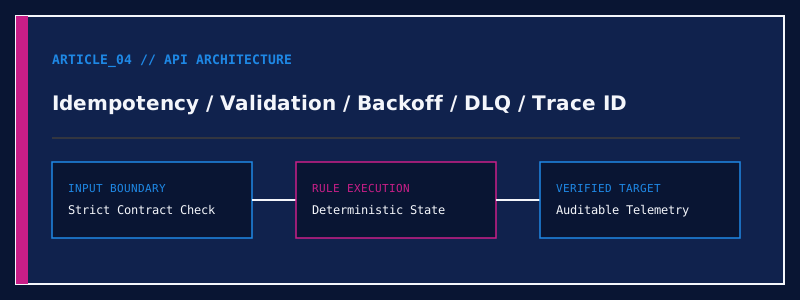
Section 01
1. Idempotency and Duplicate Webhook Protection
Most cloud platforms use "at-least-once" delivery for webhooks. That means if your server takes slightly too long to acknowledge a webhook, the sender will fire the exact same event a second or third time. Without idempotency checks—tracking processed event IDs or deterministic business keys—your integration will create duplicate orders or double-charge invoices.
Section 02
2. Strict Boundary Schema Validation & 3. Rate-Limit Backoff
Never trust incoming payloads implicitly, even from established vendors. Validating payload structure at the boundary ensures that an unexpected null field or string-encoded number fails fast with a clear log entry rather than causing a subtle calculation error downstream.
Similarly, outbound API clients must respect HTTP 429 (Too Many Requests) responses, reading Retry-After headers and applying exponential backoff with jitter so batch jobs do not get your API credentials temporarily blocked.
Implementation Checklist
- [✓]Check 1: Idempotency keys to prevent duplicate record creation on retries.
- [✓]Check 2: Strict input schema validation before executing business logic.
- [✓]Check 3: Exponential backoff and Retry-After handling for HTTP 429/503 responses.
- [✓]Check 4: Dead-letter queues (DLQ) so failed payloads are preserved for replay.
- [✓]Check 5: Correlation IDs attached to every log line across systems.
Section 03
4. Dead-Letter Queues and 5. Correlation IDs
When a payload fails due to a business rule violation (such as an unknown SKU), dropping it on the floor is unacceptable. Routing failed payloads to a Dead-Letter Queue (DLQ) with a shared Correlation ID lets operators inspect the exact payload, fix the missing SKU in the target system, and replay the message without losing data.