
Skip to content
Service 08Automation & Support

Workflow Orchestration

Manage complex multi-system sequences where Step B must wait for Step A, with clear state tracking, retries, and compensation logic.

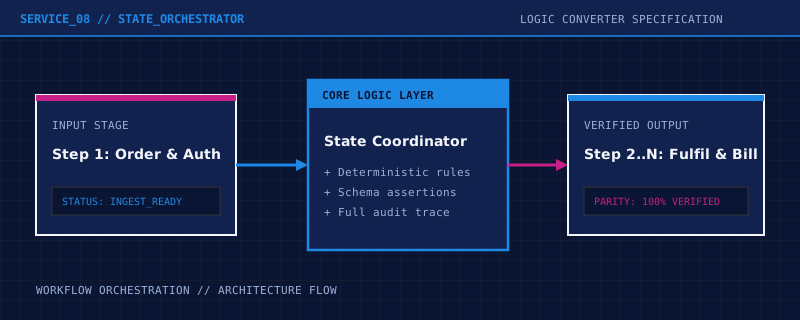
Workflow Orchestration architecture flow diagram showing input stage, core logic layer, and verified output

01 · Problem & Audience

Why organisations need this

When a business process spans four or five systems—such as order capture, payment verification, inventory allocation, warehouse dispatch, and invoicing—simple point-to-point webhooks quickly turn into a tangled web. If step three fails halfway through, nobody knows which systems were updated and how to resume cleanly.

Designed For

  • Engineering and operations teams managing multi-stage processes across several platforms.
  • Businesses running dozens of uncoordinated cron jobs that occasionally collide or run out of order.
  • Organisations needing central visibility into in-flight transactions.

02 · Scope & Process

How we execute Workflow Orchestration

Phase 01

State Machine & Dependency Mapping

We map every step of the workflow, defining pre-conditions, timeouts, retry policies, and rollback/compensation actions.

Phase 02

Orchestrator Implementation

We implement a central coordinator service or workflow engine that tracks the exact state of each job run.

Phase 03

Idempotency & Recovery Wiring

We ensure failed steps can be re-triggered from the point of failure without re-running completed earlier steps.

Phase 04

Operational Visibility Setup

We expose run histories, duration metrics, and alerting for stalled workflows.

03 · Practical Benefits

Operational Outcomes

  • +End-to-end visibility into where every multi-step job is at any moment.
  • +Safe resumption from failed steps without duplicating upstream actions.
  • +Elimination of race conditions between overlapping scheduled scripts.
  • +Centralised timeout and SLA monitoring for business-critical sequences.

04 · Deliverables

What You Receive

  • →Workflow state-machine specification and sequence diagrams.
  • →Orchestration service and task worker definitions.
  • →Retry, timeout, and dead-letter handling configuration.
  • →Operator guide for inspecting and replaying failed workflow runs.

05 · Boundaries & Dependencies

Scope Limitations

Transparent engineering constraints

  • External systems participating in a workflow must support either status polling, webhooks, or idempotent retries to guarantee exact state recovery.

06 · Service FAQs

Common questions about Workflow Orchestration

How is orchestration different from simple API integration?

A simple integration moves data from A to B. Orchestration manages a multi-step journey (A → B → wait for approval → C → D), tracking state and handling partial failures across the whole sequence.

Can workflows wait for human approval or external events?

Yes. Orchestrated workflows can pause at a defined state for hours or days waiting for a webhook callback or staff sign-off before continuing.

What happens if a downstream system rejects a step?

The orchestrator logs the exact error, halts dependent downstream steps, and can either trigger compensating rollback actions or alert an operator to fix the payload and resume.

09 · Project Enquiry

Scope your workflow orchestration project.

Outline the applications, data formats, or rules involved. We will review your constraints and propose a structured path forward.