
Where do data quality checks sit in our architecture?
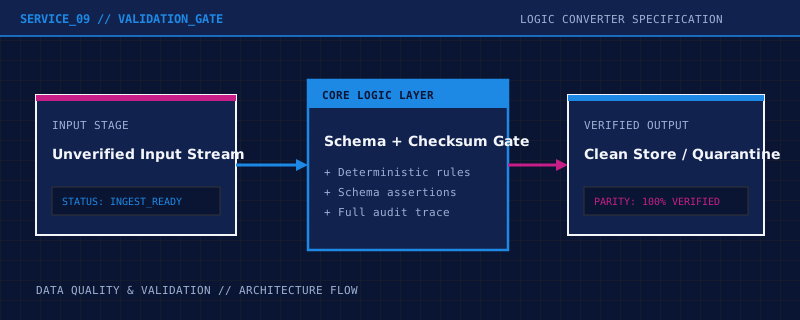
They can run at the ingestion boundary (rejecting bad API payloads or CSV rows immediately), inside transformation pipelines, or as scheduled reconciliation audits across databases.
Catch malformed records, missing mandatory fields, and duplicate entities at the boundary before they pollute downstream systems.
01 · Problem & Audience
Bad data compounds quickly. A missing tax code, an invalid Australian Business Number (ABN), a malformed phone number, or a duplicate customer ID entered in one system can cause invoice failures and broken reports across three other platforms.
Designed For
02 · Scope & Process
Phase 01
We define structural rules (types, lengths, regex patterns), domain rules (ABNs, postcodes, valid SKUs), and relational rules (foreign key existence).
Phase 02
We build validation schemas and assertion checks into your ingestion pipelines or API endpoints.
Phase 03
We implement deterministic and normalisation-based matching to flag or merge duplicate records.
Phase 04
We configure clear daily or per-batch digests showing pass rates and specific validation failures.
03 · Practical Benefits
04 · Deliverables
05 · Boundaries & Dependencies
Transparent engineering constraints
06 · Service FAQs
They can run at the ingestion boundary (rejecting bad API payloads or CSV rows immediately), inside transformation pipelines, or as scheduled reconciliation audits across databases.
Yes. We implement checksum validation for ABNs/ACNs, Australian phone/mobile normalisation, state/postcode rules, and BSB formatting.
We normalise names, emails, phones, and identifiers first, then apply configurable matching rules—auto-merging exact matches and flagging near-matches for staff review.
07 · Companion Capabilities
Data Transformation Pipelines
Deterministic validation, mapping and controlled transformation workflows for complex formats.
Data Migration Planning
Map source-to-target fields, clean historical records and validate migration readiness before cutover.
ETL and ELT Pipeline Development
Structured extraction, loading and transformation pipelines for reporting and operational data warehouses.
08 · Technical Reading
Why Business Integrations Fail Without Clear Data Ownership
Most integration bugs are not caused by broken HTTP requests—they happen because two systems both believe they own the same customer, inventory, or invoice record.
Data Engineering · 7 min readETL vs ELT: Choosing the Right Data Pipeline Approach
Should you clean and reshape data before it reaches your target database, or load raw records first and transform them in place? Here is how to choose based on governance, volume, and maintainability.
Migration · 8 min readHow to Plan a Low-Risk Data Migration
Data migrations fail when treated as a last-minute CSV import before launch. A structured plan with automated reconciliation turns cutover weekend into a predictable checklist.
09 · Project Enquiry
Outline the applications, data formats, or rules involved. We will review your constraints and propose a structured path forward.