
ETL vs ELT: Choosing the Right Data Pipeline Approach
Should you clean and reshape data before it reaches your target database, or load raw records first and transform them in place? Here is how to choose based on governance, volume, and maintainability.
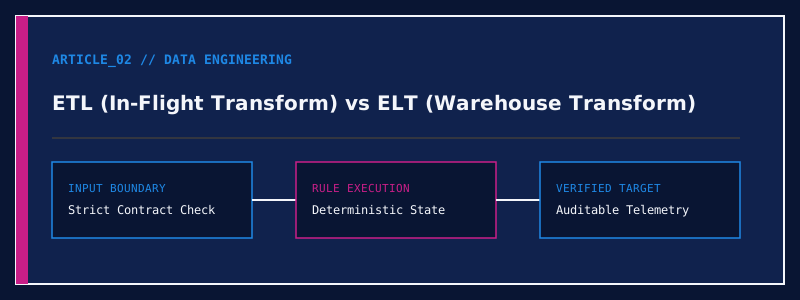
Section 01
How ETL and ELT Differ in Practice
In a traditional Extract, Transform, Load (ETL) pipeline, data is extracted from source systems, processed through an intermediate transformation engine or worker script that cleans, filters, and reshapes the records, and only the final structured output is written to the destination database.
In an Extract, Load, Transform (ELT) pipeline, raw records from source APIs or databases are loaded directly into isolated staging tables inside the target data warehouse. Transformations are then executed as version-controlled SQL queries that build clean analytical or operational tables from that raw staging layer.
Section 02
When ETL Is the Better Engineering Choice
Despite the popularity of cloud warehouses, transforming data before loading remains essential in several operational scenarios. If you are pushing records directly into a third-party SaaS API (such as an accounting system or CRM), there is no staging warehouse—payloads must conform strictly to the target schema before the HTTP request is sent.
ETL is also preferred when regulatory or privacy rules require stripping sensitive personal fields (PII) or hashing identifiers before data leaves an on-premise boundary.
Implementation Checklist
- [✓]Operational system-to-system syncs where the destination is an application API.
- [✓]Pipelines requiring strict PII redaction or anonymisation prior to storage.
- [✓]High-frequency stream filtering where storing raw noisy logs is cost-prohibitive.
Section 03
When ELT Simplifies Debugging and Historical Backfills
For consolidated reporting and analytics, ELT offers a major operational advantage: replayability. When business logic changes—for example, Finance revises how bundles or discounts should be categorised—an ELT architecture lets you update your SQL transformation logic and re-run it against the preserved raw staging tables without re-fetching years of data from rate-limited external APIs.