
What if our legacy software has no API at all?
We look at supported batch import/export mechanisms (CSV/XML/fixed-width over SFTP or local folders), ODBC/JDBC read views, or vendor-approved SDKs.
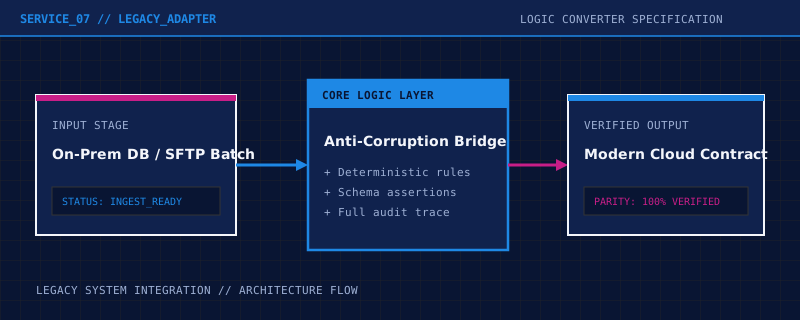
Bridge proven legacy systems with modern cloud applications without risking core operational stability.
01 · Problem & Audience
Many established Australian businesses rely on dependable older ERP, manufacturing, or accounting systems that lack modern REST APIs. Replacing the core system may be unnecessary or years away, yet modern customer portals, e-commerce stores, and mobile tools need to exchange data with it safely.
Designed For
02 · Scope & Process
Phase 01
We examine safe integration points: supported import/export utilities, read-only database replicas, stored procedures, SOAP endpoints, or watched directories.
Phase 02
We design an adapter service that translates legacy schemas and encodings into clean modern JSON contracts.
Phase 03
We implement strict concurrency limits, queuing, and validation so cloud traffic spikes never overwhelm the legacy host.
Phase 04
We test thoroughly in non-production windows and deploy with circuit breakers and detailed audit logs.
03 · Practical Benefits
04 · Deliverables
05 · Boundaries & Dependencies
Transparent engineering constraints
06 · Service FAQs
We look at supported batch import/export mechanisms (CSV/XML/fixed-width over SFTP or local folders), ODBC/JDBC read views, or vendor-approved SDKs.
Yes, when architected properly. Rather than opening inbound firewall ports to the legacy server, an outbound-only agent or secure VPN/tunnel can pull queued tasks safely.
Yes. Because modern apps talk to the adapter’s clean contract rather than the legacy system directly, swapping out the backend later requires far less rework.
07 · Companion Capabilities
System Integration Consulting
Assess existing applications, data hand-offs and architectural requirements before writing integration code.
Data Migration Planning
Map source-to-target fields, clean historical records and validate migration readiness before cutover.
Data Transformation Pipelines
Deterministic validation, mapping and controlled transformation workflows for complex formats.
08 · Technical Reading
09 · Project Enquiry
Outline the applications, data formats, or rules involved. We will review your constraints and propose a structured path forward.